


Hey everyone! Before we get into it, we are running a 20% Black Friday-Cyber Monday dealheck it out here:
Now onto markets…
Assuming you have read my previous note, I posited that the move higher in NVDA on Monday would benefit that one stock, and allow for continued tightening as a headwind, with rates being the overhang. Approximately half that move off of lows has now given back. QQQ -2.0%, SPY -0.7% today.
NVDA has given back much of Monday’s gain and HYG remains below resistance with about 65 bps of hiking priced in. So while the direction of travel has been as expected I would like to outline the reasons behind today’s sell-off. Only about 1 bps moved on 2yr today so clearly the rate of increase in cost of funds wasn’t the driver.
Lower than expected server gross margins at HPE and a similar performance by ADI (following a beat) combined with reports that the US may impose additional tariffs on 16 countries resulted in today’s broad-based weakness. All signs of a flight to safety can be seen today with copper falling 4% to a low not seen since March, gold falling 2% to lows of the year and Bitcoin below $60k. Three of four of my measures of “risk off” are now positive. Of course many of the smaller caps were positive with the Equal Weight S&P and Russell both gaining ground.
Most houses will attribute much of today’s weakness to profit taking following an enormous move in the sector and some concern over potential additional tariffs. With Dec now fully priced at 25 bps they will want to know if we’ve seen the bottom of the AI trade and if Huang’s comments will bring this chapter to a close. However I believe the comments made by HPE deserve much more attention with regard to implications for future economic activity and potential tightening. Clearly continued investment in AI will be beneficial for GDP as long as this continues to rise. However returns on that investment appear to be declining. So all of the negative implications fall on those investing in and financing these projects.
Therefore although many will see these moves as indicative of greater macro concerns I believe most are merely a result of overextended positions in copper, gold, Bitcoin and high yield. Only the prospect of additional tariffs on top of current levels of tightening has yet to be priced into the yield curve.
The Economy Remains Strong With Only One Over-extended Position
I don’t see any change to fundamentals since my last note. Nowcast of 3.2%, initial claims near 203k, average payrolls of +137k over 3 months and real consumer spending increasing at about 3% pa. Core PCE at 3.12%, services (ex-energy) increasing at more than 4% pa and PPI up 6.5% yoy. Following the increase of 25 bps at the last meeting Dec is already priced and the forward curve peaks at 4.56% in July, implying continued strong economic activity with a lagged response.
As always I look at various combinations of growth, inflation and liquidity to see if any combination dominates. In this case all periods show strong idiosyncratic moves, although 3 of the 4 risk-off indicators I look at are positive.
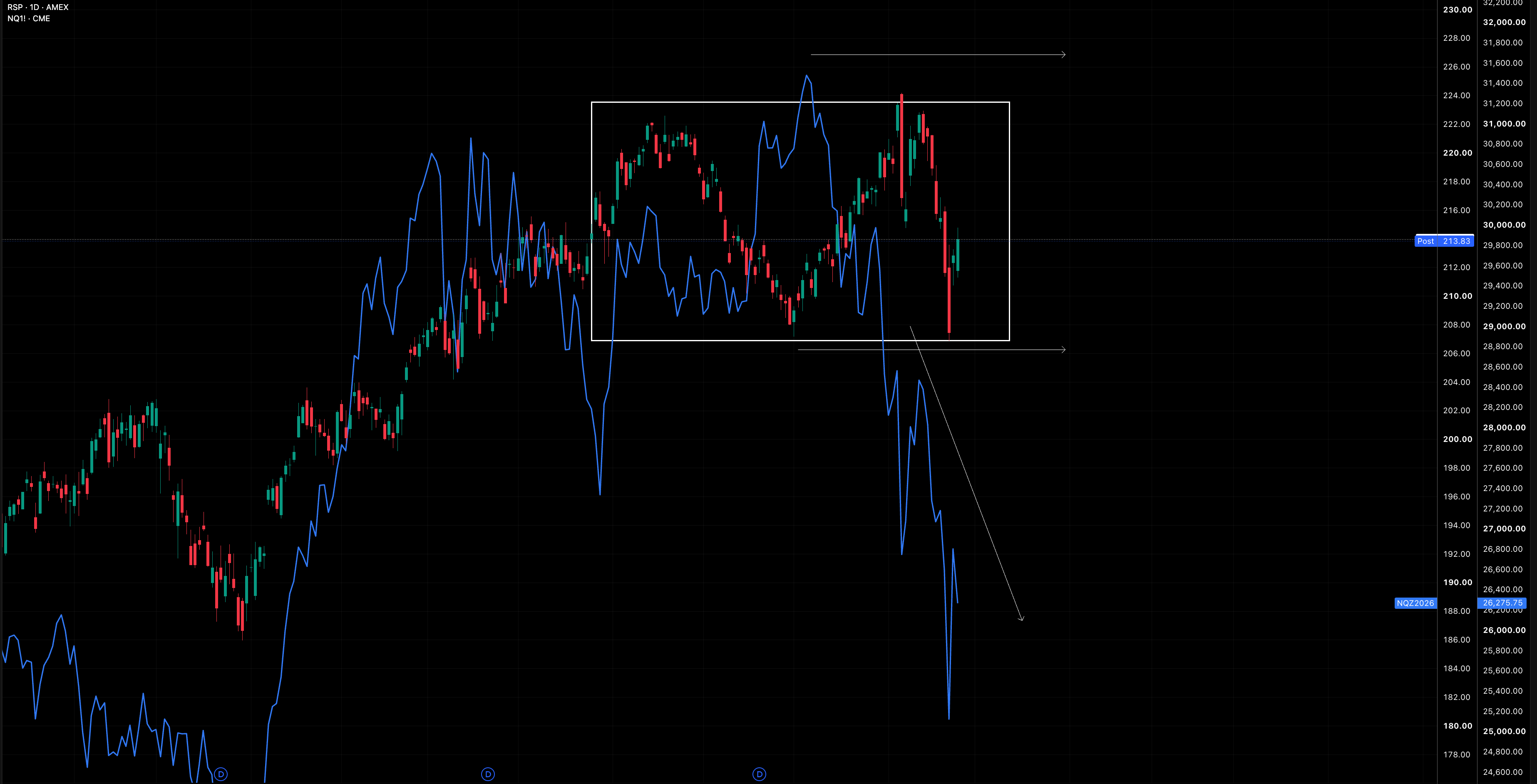
Note how the Equal Weight index remained relatively flat despite significant weakness in the large cap heavy Nasdaq 100.
As you can see, it’s straightforward: both Alphabet and Amazon underperformed around 28-29th October raising questions about the benefit of increased spend. The Democrats taking control on the 3rd of November introduced more chance of regulation. By 12th Huang was out as CEO of Nvidia and there was no positive effect from the Anthropic IPO. From the 16th through the 20th the S&P 500 gave up 8.6%, entering a correction. On the 23rd the board voted 100% to reappoint him, stating amongst other things they had received “information from various senior government officials” in the US. On that day the S&P rose 4.73%, its biggest gain since April 2025.
All internal and state and federal probes into Nvidia are ongoing. Additionally Anthropic continues to trade beneath its IPO level. All therefore still relevant as triggers for continued selling. Over this 20 day period the Tech sector dropped almost 13% while all other sectors roughly flat. Equal Weight -2%, and 2y moved around a tenth of average. See below how extreme this is: no meaningful move for Equal Weight but Nasdaq 100 taking the brunt.
So which test? I think the difference is telling. All aspects of the price test are negative: 2y, Fed Funds, and average stock vs broad market. The majority aspects of the risk aversion test positive: spreads, VIX, slope of yield curve and safety assets. Presumably one can have both conditions simultaneously, if selling includes a broad range of assets: credit, commodities, crypto and stocks.
Monday provided textbook example: almost 11% excess return for the highest Beta stocks, and over 8% for popular retail names. All-time high on my measure of stress from factors. Little change on the ranks. All holding similar positions sold off together. The converse occurred yesterday. Down around 16% for HPE, ADI, 12-13% for CoreWeave, IREN. Up 10-20% for Abercrombie, Dick’s, and Kohls. After these 2 days the outlook on the general economy, inflation (excluding core), and Fed rate expectations remain almost unchanged.