



Firstly, I just wanted to inform you guys that I am hosting Market Macro Hub’s first livestream on October 26th at 4pm BST with Less Noise More Signal. I have done a previous recording with this channel and I HIGHLY recommend that you subscribe to all social media content from them:
Less Noise More Signal - Youtube
Less Noise More Signal - Substack
Less Noise More Signal - Twitter
This was the previous recording:
This report today is slightly different.
I am going to be producing a LOT of additional content, alongside the structured macro reports, daily systematic models and continuously sharing live market thoughts & models.
This report here is written as a joint report with my good friend Kymani Steer, who is predominantly a crypto trader & analyst, coder and global macro researcher.
Let’s dive in!
We are seeing the rapid emergence of financial trading onto blockchain networks creating many different opportunities in the world of decentralised finance. In particular, this moment is defining as many development teams publish to the world their version of how investors should access markets via blockchain technology. Established competitor Hyperliquid is an exchange based on an order book model, whereas the focus of today’s writing Variational takes a different approach.
Variational has its own embedded market maker known as the Omni Liquidity Provider (OLP) who quotes the users prices for assets. Upon the user accepting the quote, OLP that takes the other side of the trade and manages exposure to the position. This design allows for users to be able to trade a variety of traditional assets alongside crypto with ease. The collateral for the positions is secured on the Arbitrum network, an Ethereum Layer-2. The distinction between Hyperliquid and Variational lies in how they provide liquidity. Hyperliquid brings trade participants together on the order book whereas Variational’s Omni platform utilise a dealer-based model quite similar to what we see in traditional finance.
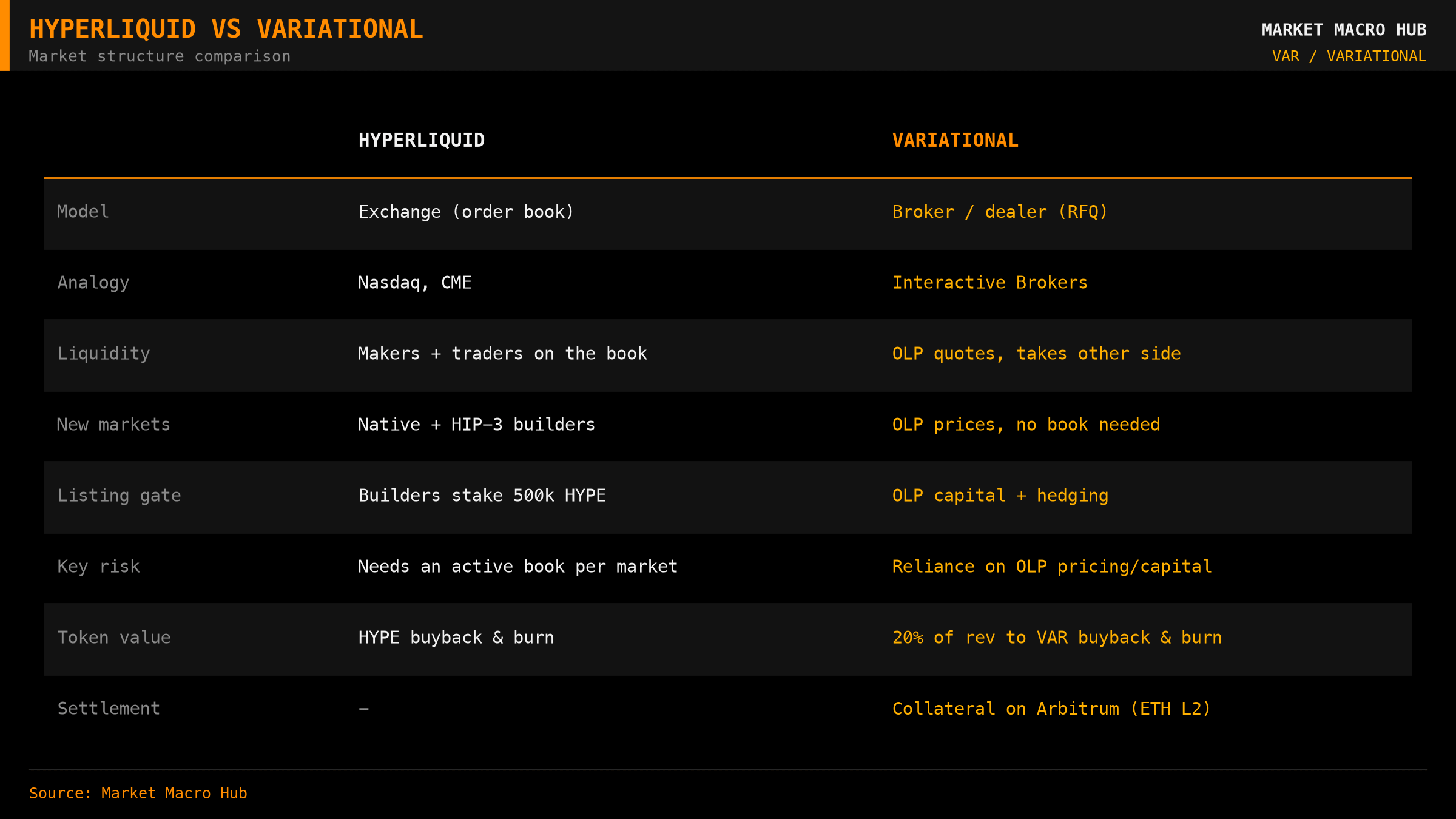
The way how Hyperliquid and Variational launch new markets is very different. Hyperliquid has a variety of ways to launch new markets: both natively and via its introduced HIP-3 protocol. HIP-3 allows for permissionless opening of new markets by independent operators (known as builders) given they stake at least 500,000 HYPE as collateral for safety purposes. Trade.xyz is currently the leading builder and has deployed multiple markets covering stocks, indices and commodities on Hyperliquid. Builders define the market and rules surrounding it such as the maximum leverage and what external price does the market track. Once a market goes live, market makers and traders provide buy and sell orders to effectively price the market well. Comparing this to Variational, the immediate advantage is that it can offer a new market without having to develop an active order book for that asset. OLP provides the pricing which crucially needs to be reliable and accurate and needs to have sufficient capital and way to hedge and manage its exposure. The subsequently can allow for much broader market coverage but brings forth greater reliance on the mechanisms behind OLP.
Appearing on the When Shift Happens podcast, Variational’s CEO Lucas Schuermann gave the comparison of Hyperliquid being similar infrastructure wise to the exchange such as Nasdaq and CME whereas Variational was much similar to brokerage such as Interactive Brokers. He made it clear that he believes both products can coexist where exchanges provide trading venues whilst brokers connect customers to liquidity across them. The underlying conclusion that remains is which product offers customers the most competitive trading experience. This competitive experience is based on execution and cost of completing the transaction.
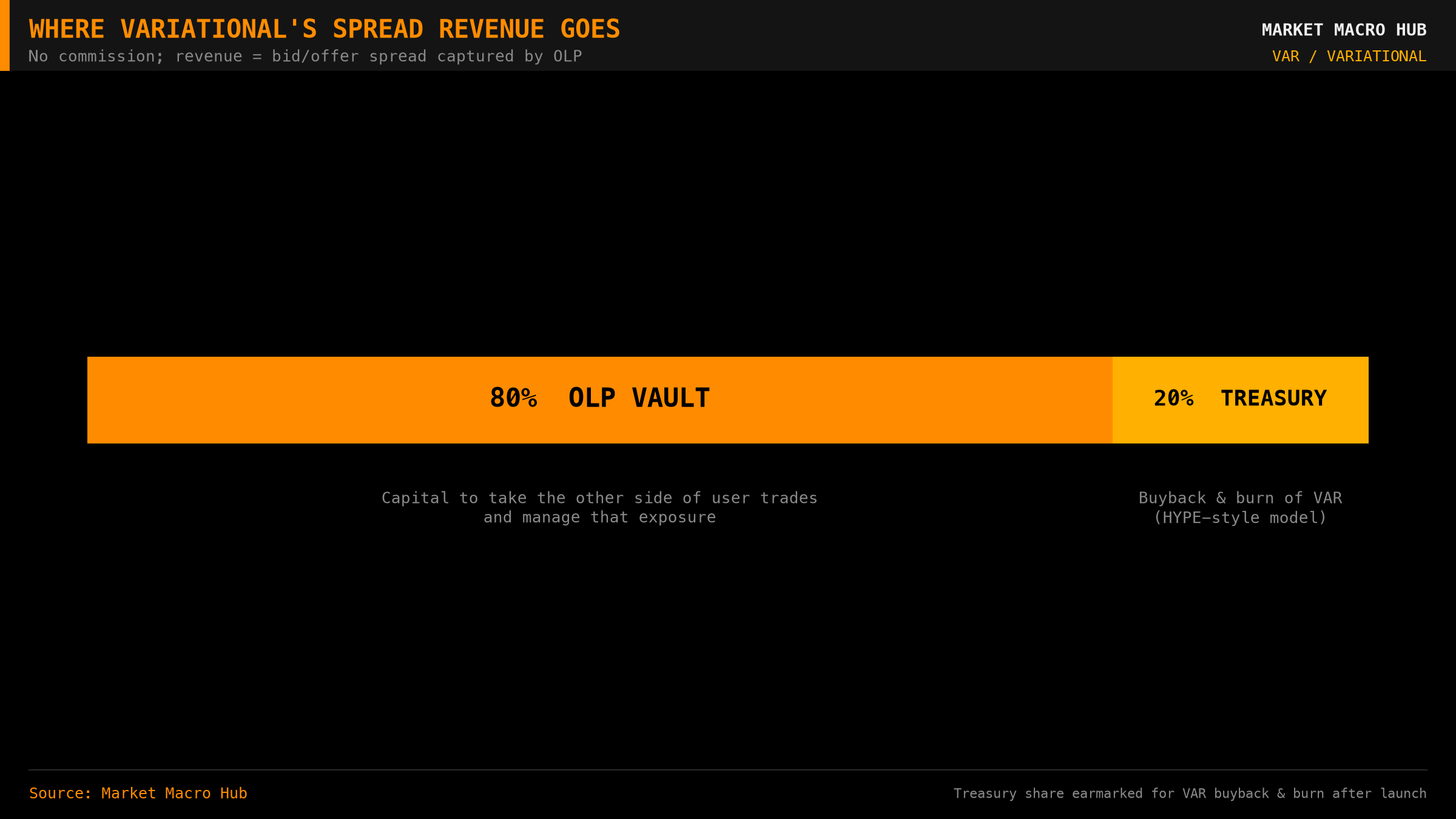
Investors simply want to understand how does the trading activity on Variational translate into value for VAR, its planned token to launch in Q4. Variational’s current revenue model works on basis of no commission but captures the difference between spread on buy and sell prices. 80% of this revenue stays within the OLP vault, which is used for managing and supply exposure to trades (given it takes the other side of user trades). The remaining 20% is redirected to the protocol’s treasury where they are currently awaiting to be utilised for token buy back and burning of VAR tokens from circulation once it officially launches. This is a similar measure that Hyperliquid does with their HYPE token creating a link between platform adoption and demand for the token.
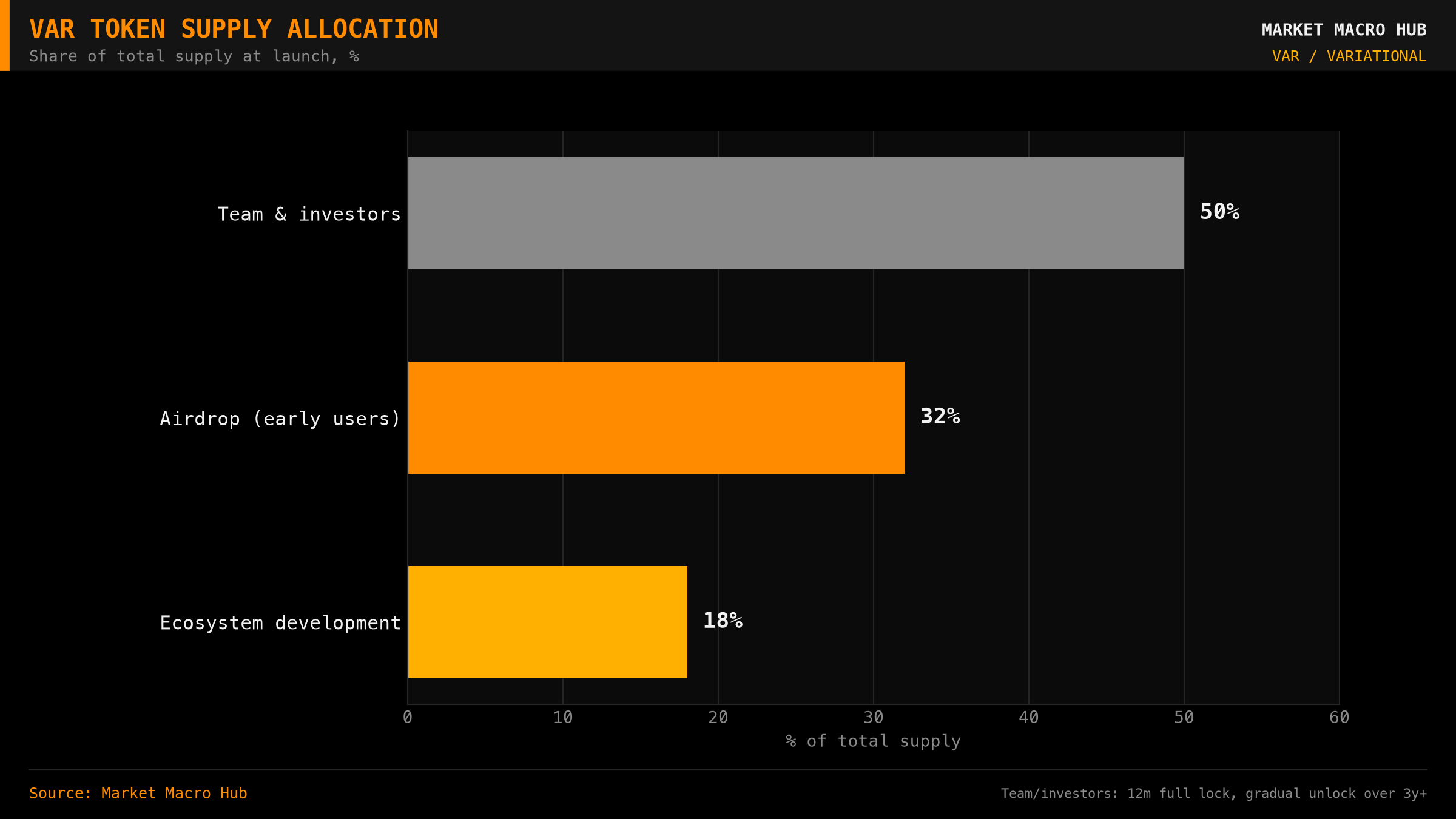
Upon the VAR token launch, 32% of the supply will be allocated to early users eligible for an airdrop which is determined based on their trading activity that accumulates points. With this being the immediate catalyst, the longer-term investment case will depend on whether such early users can be retained alongside new users once the farming incentives end. 50% of the supply is allocated to the team and investors, locked fully for 12 months with a gradual unlock over a period of at least 3 years. Another 18% is earmarked for ecosystem development. These allocations matter alongside demand when assessing the token’s valuation.
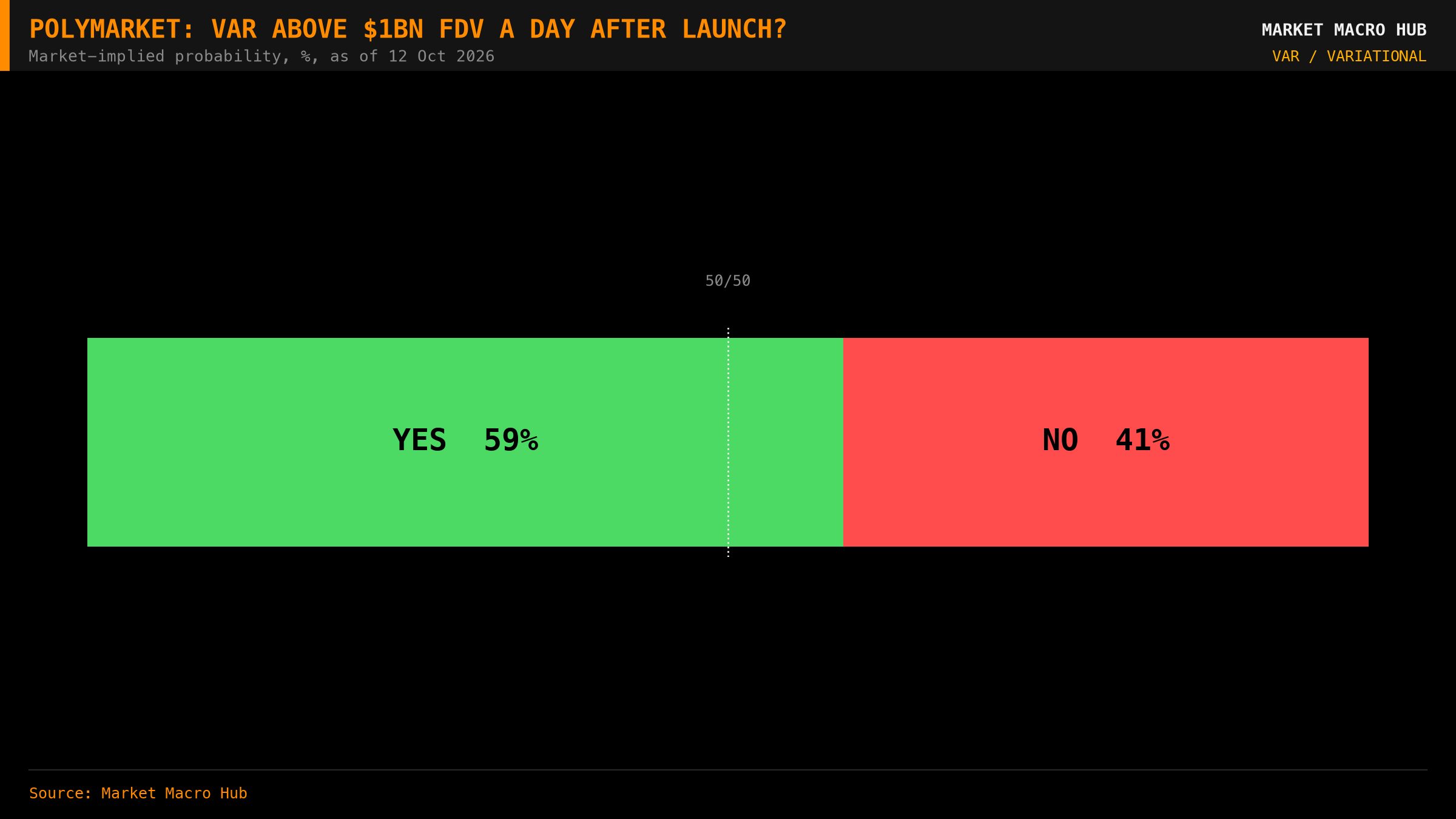
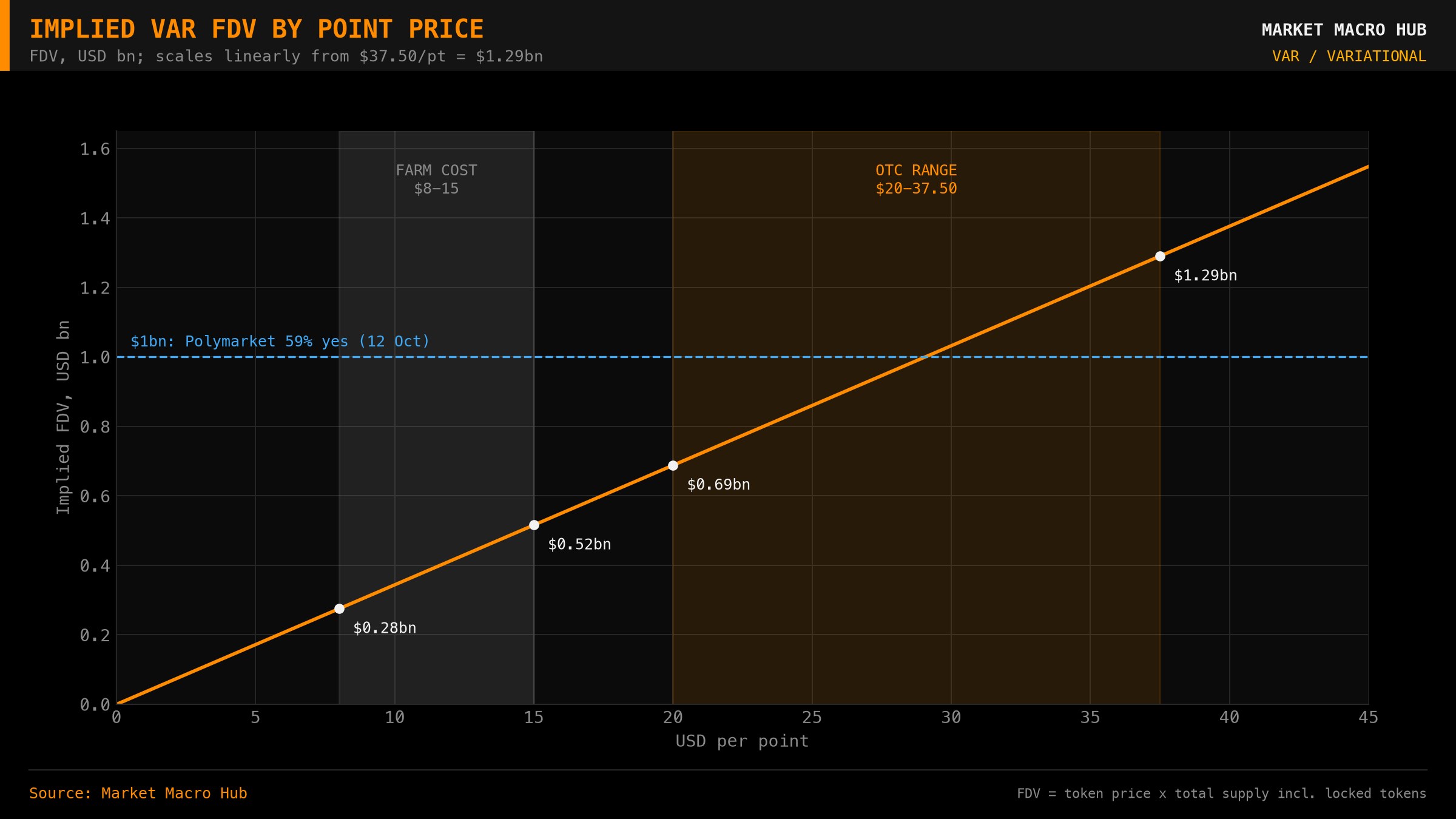
We are now wondering, what would the launch valuation possibly be? As of the 12th October, Polymarket displays a 59% probability of VAR exceeding $1 billion fully diluted valuation (FDV) a day after launch.
FDV = token price x total supply (including locked tokens).
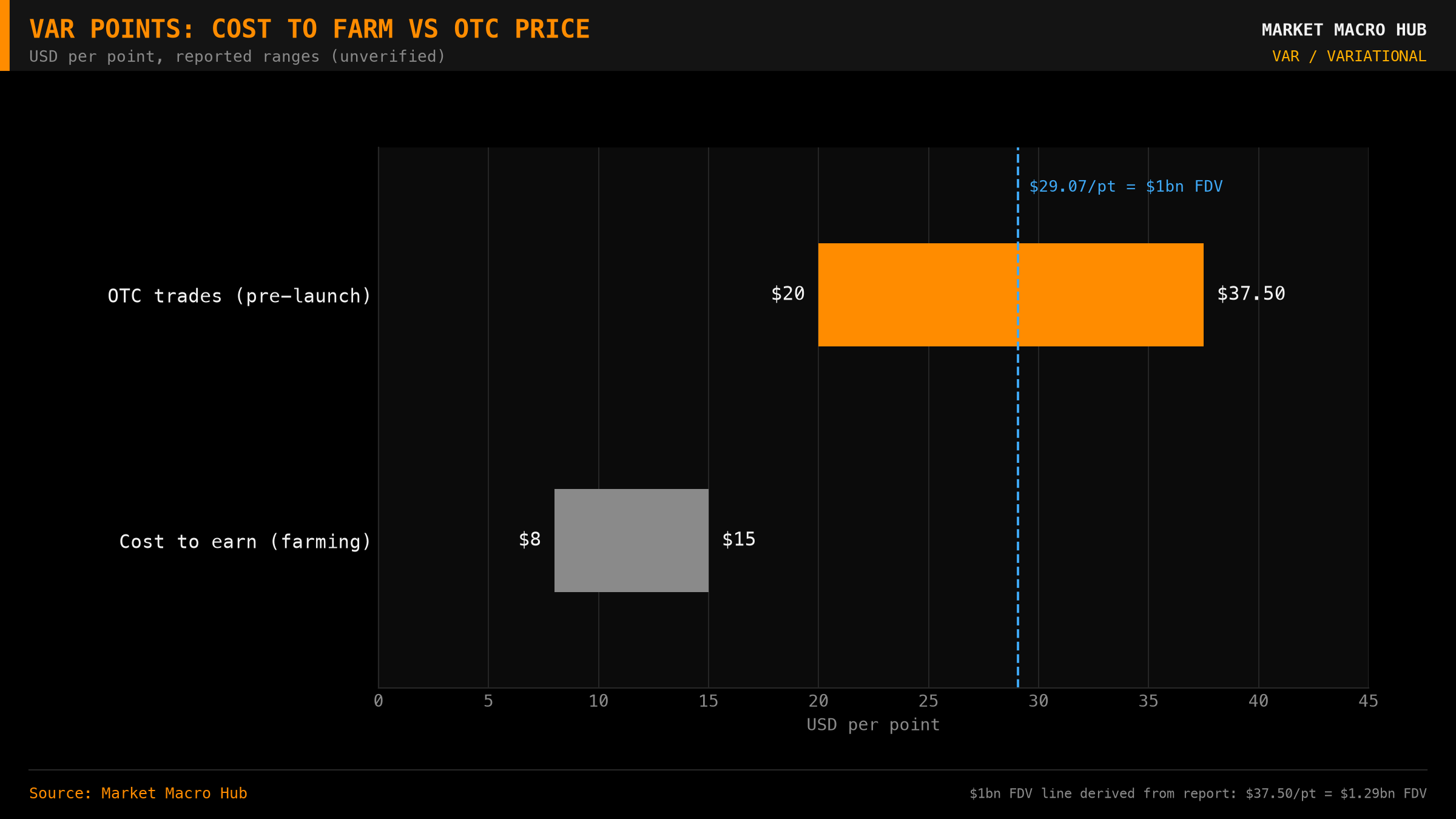
Reports in the crypto space surrounding OTC transactions for points prior to launch have taken place at prices of $20-37.50 per point which would imply an FDV of $1.29 billion at the upper bound. Traders on social media report earning points are currently at a cost of around $8-15 each. The farming of points takes place through engaging in trading activity on Variational, mainly delta neutral strategies by taking offsetting long and short position across various exchanges on assets with favourable funding rates and low cost to execute. It is important to note that these still positions still carry liquidation risk if not handled correctly. These estimates are unverified, however, earning points through such farming methods could prove profitable if VAR launches at a valuation consistent with the expectations laid out above or higher.
Post launch, the longer-term investment case strongly lies on whether users can be retained into the future alongside the growth revenue so that the revenue buy back model can continue as we have seen with the success of Hyperliquid. In the bull case scenario, the broad access to a range of markets (especially Trad-Fi based assets) could attract a lasting demand allowing for the token buy back and burn events to continue with the bearish scenario being such demand dies when the incentives disappear. The current and past trajectory of Hyperliquid and Lighter are useful comparisons for the potential of VAR, but cannot be held as a guarantee.
I’ll end with the question being: how much of that future success is already reflected in the launch price?
Now onto the macro backdrop and what I want to see after the CPI release to adjust or add to the positions sent out to paid subscribers.
